 Velocity Partners
Insights · The AI Range, part 3
From the range to the course
Individual practice builds the swing. Organizations face a harder problem: turning AI experiments into results that show up on the P&L.
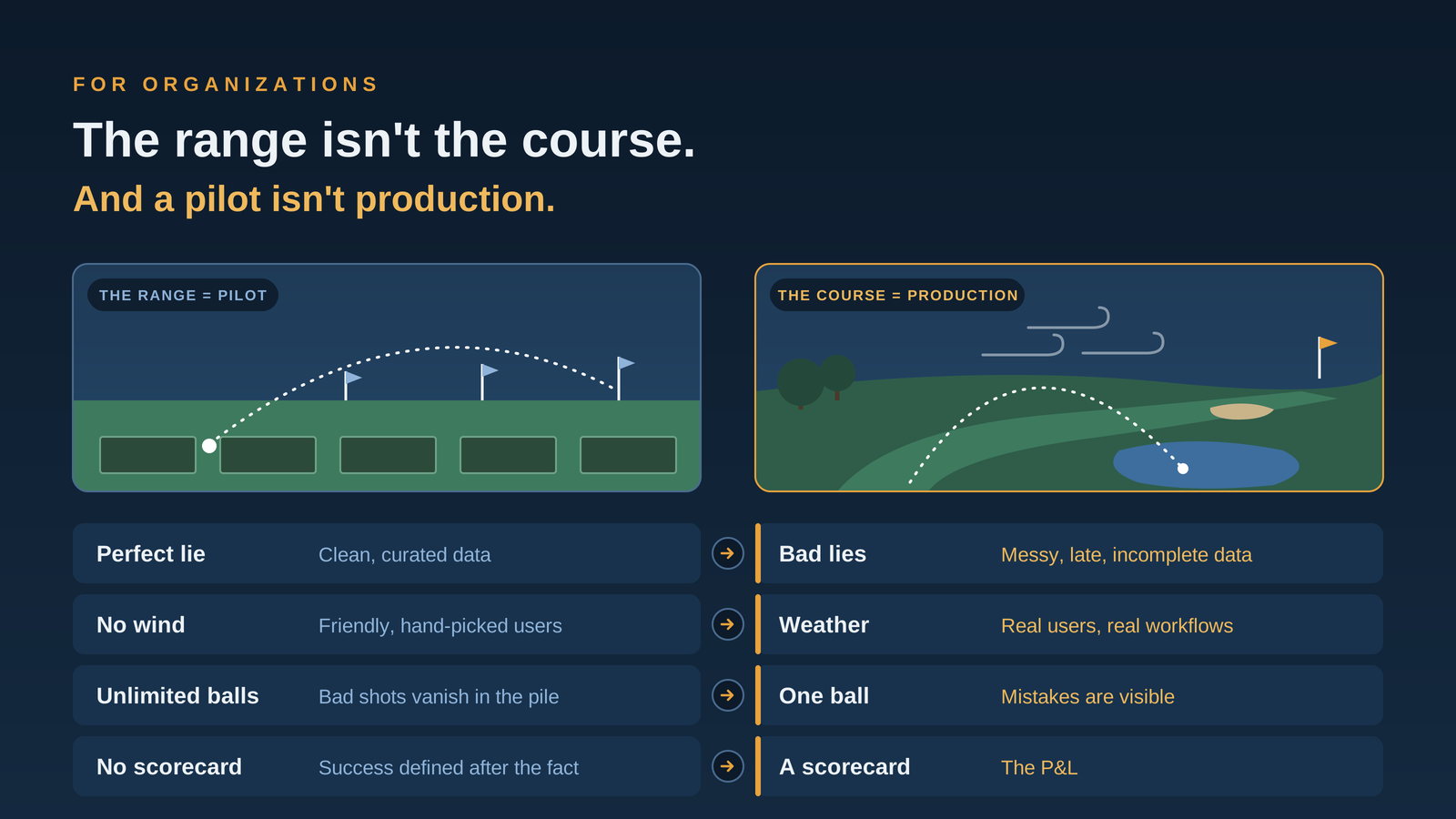
Every golf club has a player who flushes it on the range, ball after ball, then takes it to the course and shoots 95. The range isn't the course. And an AI pilot isn't production.
Most AI pilots are range sessions. Clean, curated data. Friendly, hand-picked users. A success metric chosen after the results came in. Of course they look good. Then they meet the course: messy data, real workflows, users who didn't volunteer, and a scorecard that counts.
At Polk (IHS Markit), I led teams that operationalized more than 800 machine learning models. The modeling was rarely the hard part. The course was: data pipelines that broke, models that drifted as the market moved, and users who needed the answer inside a system they already used, not a new dashboard.
Play a practice round first
Before calling a pilot a success:
- Run it on real data, not a cleaned-up extract.
- Put it in front of users who didn't volunteer.
- Test it in the workflow, and on the device, where the work actually happens.
- Agree on the scorecard before the first shot.
The organization is the course
The technology is rarely what holds an initiative back. Results come when the organization changes around it: who owns the outcome, how decisions get made, how roles and budgets adapt. Organizational readiness isn't a change-management afterthought. It's the core of the strategy.
Getting from the range to the course
This is the work I do as a fractional CPO: setting the business case and the scorecard before the build, getting the data ready, and preparing the organization to use what gets built.
Earlier in the series: The AI Range →
Have AI pilots that look great on the range but haven't reached the P&L? See Fractional CPO for AI Initiatives, or book a 20-minute call.